
(Spoilers for entire series)
Here is a passage from Terry Pratchett that comes to mind when I think about Succession.
Six Beneficent Winds suddenly remembered, as a child, playing Shibo Yangcong-san with his grandfather. The old man always won. No matter how carefully he’d assembled his strategy, he’d find Grandfather would place a tile quite innocently right in the crucial place just before he could make his big move. The ancestor had spent his whole life playing shibo. The fight was just like that.
Logan Roy always wins. His son, Kendall, plots to take over his billion-dollar media empire, but every attempt fails. A board vote doesn’t work. A hostile takeover doesn’t work. Kendall’s bombshell press conference at the end of season two certainly rattled the old man for a while, and put him on the back foot… but it didn’t cost Logan the company, which remained his until the end of his life. As Logan likes to say: ‘I fucking win.’
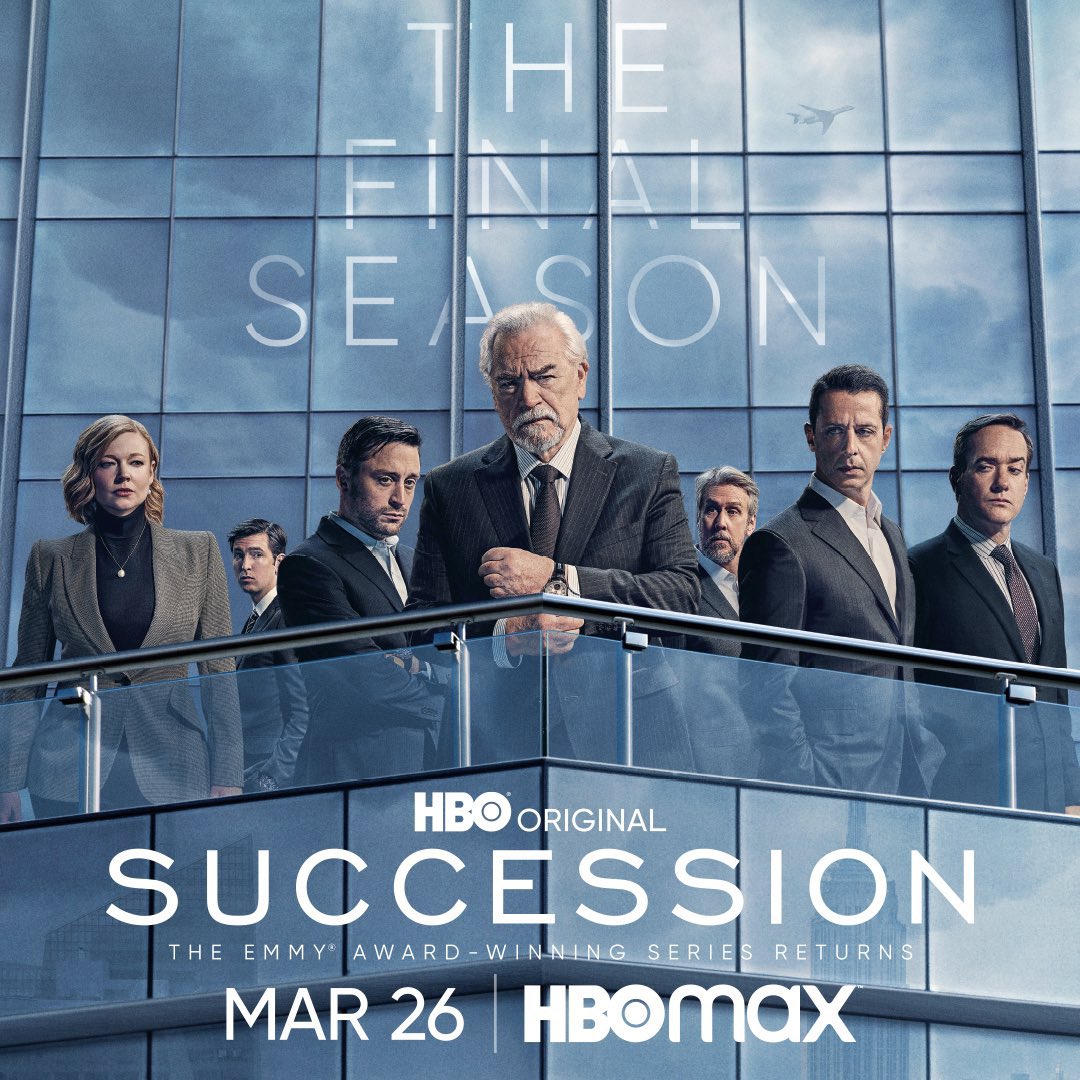
Succession is a dark comedy about the failed attempts of Kendall and his brothers to take over the empire their father started. It never took a genius to see that the brothers and sister wanted Waystar but also wanted other things from their dad – his love, support and approval. But in the world of Succession love is conditional.
Marty Byrde in the crime drama Ozark thinks of love as conditional. He resents his wife’s affair because of the sacrifices he himself made for his marriage and family – hard work, years of faithfulness, ‘Marty Byrde, putting presents under the tree since 2002.’ It’s not just entitlement that motivates him. Marty feels that he has to be constantly ‘providing’ to be worthy of love, a pathology that took hold in his own childhood, when his father died of pancreatic cancer and left Marty and his mother penniless. Whatever, the idea of not being needed (and thus loved) is unmooring for him. Marty’s uncharacteristic loss of temper in season four springs not only from his fractious marriage and perilous situation but also from the meeting with his son Jonah earlier in the episode. Jonah is by this point living in a motel, making his own money and doesn’t even need Marty to drive him to school – the kid has a bike for that. (The bicycle appears in the opening O symbol intro for that episode, just below a drawing of Marty’s clenched fist.)
Logan’s situation is less stressful. He doesn’t need love because he’s learned to live without it from an early age, and he doesn’t care about his legacy, because he can’t imagine a world in which he isn’t alive. ‘Everything is moving,’ he tells Shiv, and that’s what Logan’s life is about: movement, and momentum. He is afraid, nevertheless, that his children will steal his life’s work, or perhaps seek to end his life altogether. (When Kendall makes a meal for him Logan offers a portion of the food to Kendall’s own son, to rule out poisoning.) Day to day, Logan makes considerable effort to keep them fighting each other rather than teaming up against Logan himself.
It’s surprising how successful this strategy proves. Shiv has built a successful career outside the family, running campaigns for candidates whose politics her father abhors. Yet she junks it for a nod and a wink from Logan. (Even Shiv’s look changes dramatically once she believes she is in the running; she goes from season one’s messy hair and big jumpers to the more corporate and streamlined look almost overnight.) Kendall is the strongest threat to Logan’s position so he needs a harder line. Season two is one long demonstration of Logan’s power over Kendall. Logan makes Kendall cut his rehab short to defend his father on the news. Logan makes Kendall gut his favourite acquisition because you have to kill what you love to prove your loyalty to Logan Roy.
‘As a concept, ‘the family’ has worked even harder than ‘the individual’ to overshadow our ethical obligations to other people,’ writes Zoe Hu. Over the series we’ve seen what the Roys do to each other, and to the lesser one per centers in their orbit. Think of all the people who enjoy big arcs in Waystar world only to suddenly, inexplicably disappear: Roman’s girlfriend Tabitha and his former partner Grace (storms out of a Thanksgiving, never to return) Kendall’s PA Comfrey, Logan’s girlfriend Carrie, riding the subway back to her little apartment. Inflitrating the Roy Inner Ring takes effort and surviving there takes more. Small town company man Tom Wambsgans made a good move in marrying Shiv: ‘You married me for my DNA,’ she later tells him, accurately. When he realised that the marriage did not guarantee advancement or even fidelity on Shiv’s part, Tom pivoted to Logan. He became Logan’s conduit to what Shiv was thinking, and even offered to go to prison on the old man’s behalf. Unlike with Greg, who in his way is just as terrible, I never warmed to Tom Wambsgans. (Wasn’t there a character in Balzac who ‘would have paid for the pleasure of selling himself?’)
What the Roys do to ordinary people is even worse. Consider the death of Andrew Dodds, a waiter at Shiv’s wedding. Lots of people killed Dodds, and his death is foreshadowed: Shiv makes a joke about killing a stripper, and Roman demonstrates a similar failure of responsibility in his satellite launch, which detonates on a smartphone screen before his eyes. The workers on the satellite launch escape death, but Andrew Dodds was not so lucky. Logan fired him from the catering team, after he interrupted the old man at a stressful moment; Greg pointed him out to Kendall as a potential source of drugs; Kendall drove Dodds into the dark country road by the river. Dodds himself had agency in his own death because he grabbed the wheel to avoid the deer. Jeremy Strong’s acting is just fantastic in the aftermath: Kendall surfaces from the river, returns to the water in an attempt to save Dodds, then gives the waiter up for dead. He jogs back to the castle, hides behind a tree to avoid being seen from a passing car, then sneaks back into the castle in his wet clothes, fireworks going off as he struggles through an open field. Kendall wakes up the next day and you see the memory hit him. He picks up his phone, then you see him realise that searching for news on a smartphone could be incriminating, so he just turns on the radio, which plays crackly gibberish. You see every thought of Kendall’s cross the actor’s face.
At best, Logan has a patrician fondness for ordinary people. Leaving the modest home of the Dodds family, he tells Kendall: ‘We give them a laugh, bit of telly, news that doesn’t talk down to them. Nice fucking people, decent fucking folk.’ Cross the Roys, though, and you can go from decent fucking folk to an NRPI. In the shadow logs of Waystar cruises, this nasty acronym denotes a victim who is unconnected to the Roys, or to anybody important, and is therefore of no consequence. Logan even says this himself, of Andrew Dodds: ‘No real person involved.’ This sets up a dividing line between father and son. Despite all his flaws, Kendall does feel remorse for Dodds, the people at Vaulter that he fired and the people raped and murdered on the Waystar cruises. Logan finds about Dodds because he has a Mike Ehrmantraut-style cleaner who found the evidence, connected the dots and cleared the crime scene. When Kendall invades the Waystar town hall in season 3, a woke prince in revolt against his father’s empire, the cleaner appears again and tells him: I know you. (In the final scene of the series, when Kendall wanders off, devastated, to the river, is the ‘cleaner’ the mysterious figure in the suit who follows Kendall to the dock and stands by him? You know, I think it might be.)
In Money by Martin Amis (dead now, o Discordia) he writes that ‘London is full of short stories, long stories, epics, farces, sitcoms, sagas, soaps and squibs, walking around hand in hand.’ The protagonist, John Self, is trying to make a movie, but is stymied by the various stars, all narcissists who have a fixed idea of how they want to be seen by the world. And the drama is secretly controlled by a villain who is high on the idea of his own victimhood. You’re bound to get drama, Self reflects, when you deal with people who want to write their own lives.
Logan has his own narrative of a self made man who started with nothing and built the gigantic Waystar corporation. His children all want to be part of that story to some degree. The siblings oppose Kendall’s hostile takeover, even though they would gain vast fortunes by going along. ‘We’re somebodies now,’ says Connor Roy. ‘Any doofus can have a few million bucks.’ It’s not just power but the idea of being part of something. The more money and power we have, the greater our chances of imprinting ourselves on the world, making the world see ourselves as we would like to be seen. That is why Kendall, among his other addictions, can’t quit the family drama. His fortieth birthday attracts the city’s biggest names but all Kendall cares about is whether his brothers and sister will be coming. Doing methamphetamine with a bunch of guys he met in a bar in New Mexico, Kendall gets along with the methheads until they start riffing on his background, and at this point Kendall gets self conscious and calls Roman to pick him up. He hates his family sometimes but ultimately feels lost without them.
‘A rich kid kills a boy,’ Logan tells Kendall, ‘and that’s all he’ll ever be.’ He lays down the choice: Kendall can own up to what he’s done and ruin the memory of Shiv’s wedding and maybe go to prison. Alternatively, Logan sketches out a brighter scenario: ‘in which father and son are reconciled.’ Kendall is part of Logan’s story or he is nothing, just a drug addict guilty of manslaughter. Shiv has her father’s gift of persuasion. She convinces Kira, a Waystar whistleblower, that if she testifies against the company’s evil deeds, that is all she will be remembered for: ‘the first line of your obituary.’ Shiv is kinder than Logan, though, in which she leaves open a possible future for Kira outside the Waystar orbit, not just reconciliation to her place within it.
All this is to answer a question I always had watching the show: why do they bother? With the wealth they must have as Logan’s children, which would allow them to do anything with their lives, it confounds me that Kendall, Roman and Shiv spent so much time and energy on Waystar Royco. I do not include Connor in this, the eldest son, commonly known as the stupidest Roy but also in a sense the wisest of them, because he had the sense to remove himself far from the corporate action. Connor is in Hannah Mackay’s words ‘a middle-aged libertarian drop-out’ but at least in the final season, he has a degree of independence and self-awareness the others lack. He has his place in New Mexico, a wife with some affection for him, and at least one friend, liberal counterpart Maxim Pierce – you can imagine them sitting up at nights drinking very expensive wine and arguing about Napoleon. The other Roys don’t seem to have anybody beyond their circle (Kendall at least has a family of his own, but has alienated them almost entirely by end series). Poverty is a curse but privilege too has the power to destroy us and make prisons of human lives.
This is really brought home at the end of season three when Kendall, Roman and Shiv discover that Logan is selling the company out from under them. Kendall has the idea to persuade their mother Lady Caroline to use her board votes to block the deal. However, Logan has already learned about this gambit and blocked it: he persuades Caroline to vote his way, in exchange for a peerage to her new husband. The kids race to Logan’s villa only to find the deal all worked out without them – without sympathy, Logan informs them that he has sold their birthright. The aghast expressions on the face of his sons and daughter are truly haunting, not the faces of adults but those described by W H Auden:
Lest we should see where we are
Lost in a haunted wood,
Children afraid of the night
Who have never been happy or good.
Why did we love Succession? Part of it (come on) was the opulence of it, the idea of seeing how very rich and important people live. Another part of it was the vulnerability of the characters, and the sense of lives predating the show. There are so many mysteries and secrets that we never get to the bottom of, and the seamless flow of argument and conversation between the characters, their in jokes and old wounds, gave us the sense that this was a real family – not serious perhaps, but real. As set decorator Sophie Newman told The Ringer: ‘nothing is new. Everything has a personality, has a history and a provenance… That’s the key, is that it’s layered.’ Layered.
 Jumpnauts has an enduring start. It begins like this:



 Max Dunbar